Step Away From the Session: The Case for Letting Your Best Work Breathe

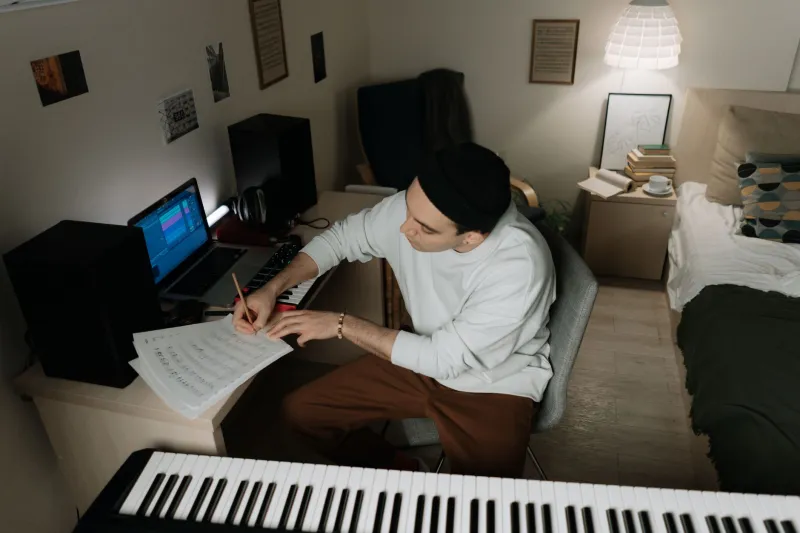
Somewhere around hour six of a studio session, something shifts. The ears start lying to you. The mix that sounded sharp and balanced an hour ago suddenly seems like it might need more bass, or less reverb, or a completely different arrangement. You make changes. Then you second-guess the changes. Then you change the changes back. By hour eight, you've convinced yourself that the whole thing needs to be scrapped and rebuilt from scratch.
It doesn't. You're just tired. But you can't tell the difference anymore, because you've been too close to it for too long.
This is studio fatigue, and it's one of the most underacknowledged creative problems in music production. The hustle culture that dominates American creative industries — the grind, the always-be-building mentality, the idea that more hours always equals better output — has made it genuinely difficult to talk about stepping away as a legitimate strategy. But the evidence, and the artists who've figured this out, suggest it might be the most important creative skill that nobody teaches.
The Ear Needs a Reset
There's actual neuroscience behind this. When you're exposed to the same auditory information repeatedly over a short period of time, your brain starts filtering it out. It's an efficiency mechanism — the nervous system stops expending resources on stimuli that aren't changing. For a producer or musician trying to make fine-grained decisions about a mix, this is a serious problem.
The technical term is auditory adaptation, and it's why professional mastering engineers almost never work on their own mixes immediately after the tracking and mixing sessions. The distance isn't just psychological — it's physiological. Fresh ears and rested ears are literally hearing more information than fatigued ones.
This isn't a new discovery. But it keeps getting ignored, because the pressure to deliver — to the label, to the collaborator, to the deadline, to the social media schedule — doesn't stop just because your ears need a break.
What Alpine Distance Actually Does
There's something specific about geographic isolation that functions as a creativity reset in ways that a walk around the block usually doesn't. In the mountains around Bern, where the nearest city is a real drive and the silence is the kind that actually registers as a physical sensation, producers and musicians describe a particular experience of returning to their work after a few days away.
The mix they were agonizing over suddenly sounds either clearly finished or clearly wrong — not ambiguous, not somewhere in the middle. The lyric they couldn't decide about resolves itself almost immediately. The arrangement question that had consumed three sessions becomes obvious.
This isn't magic. It's what happens when you stop feeding your brain new iterations of the same problem and let it do background processing instead. The Alpine setting accelerates it because the sensory break is so complete. But the principle works anywhere you can genuinely disconnect from the work.
The 72-Hour Threshold
Talk to producers who've been at this long enough to have developed real opinions about their own process, and a number keeps coming up in different forms. Not exactly 72 hours — sometimes it's two days, sometimes it's closer to four — but there seems to be a threshold somewhere in that range where the quality of the return changes.
A few hours away gives you fresher ears but not much perspective. You come back and you can hear the mix more clearly, but you're still inside the same creative headspace. Your instincts haven't had time to recalibrate.
Something different happens around the three-day mark. The work stops feeling like an ongoing project and starts feeling like a finished object — something you can evaluate rather than something you're still in the middle of making. The emotional attachment to specific choices, which is both necessary for making them and blinding when you're trying to evaluate them, loosens up. You can hear what's actually there instead of what you intended to be there.
For a lot of artists, that's when the real editing happens. Not the technical editing — the creative editing. The recognition that the second chorus doesn't need what you thought it needed, or that the bridge is carrying more weight than you realized, or that the whole thing is actually done and you've been adding things out of anxiety rather than necessity.
The Hustle Myth and the Long Game
American music culture has a complicated relationship with the idea of rest as a tool. The narrative around creative success tends to center on output — how many projects you're releasing, how consistently you're dropping content, how always-on your presence is. Taking three days away from a session doesn't make for a good Instagram story. Grinding through a 12-hour session does.
But the records that last — the ones that get pulled out ten years later and still sound like they were made yesterday — almost never came from that mode. They came from artists who were deliberate about when to push and when to stop. Who understood that the creative process has a rhythm that isn't always compatible with a content calendar.
This is partly a European thing, and it's worth acknowledging that. In music cultures shaped by craft traditions rather than hustle traditions, the idea that good work requires adequate time — including time away from the work itself — isn't controversial. It's just understood.
Making the Break Non-Negotiable
The practical challenge is that stepping away feels like falling behind, especially when you're working under deadline pressure or competitive anxiety. The solution most artists who've figured this out describe isn't willpower — it's structure.
Building the break into the process before the session starts. Scheduling the return date at the beginning, not the end. Treating the time away as part of the production timeline rather than a deviation from it. When the break is planned, it stops feeling like avoidance and starts feeling like method.
The work will still be there when you come back. And when you do come back — ears reset, perspective restored, the emotional static cleared — you'll usually find it's better than you remembered. Or you'll finally be able to hear what it actually needs.
Either way, you'll know. And knowing is the whole point.