The City That Thinks Before It Speaks — and Makes Music the Same Way
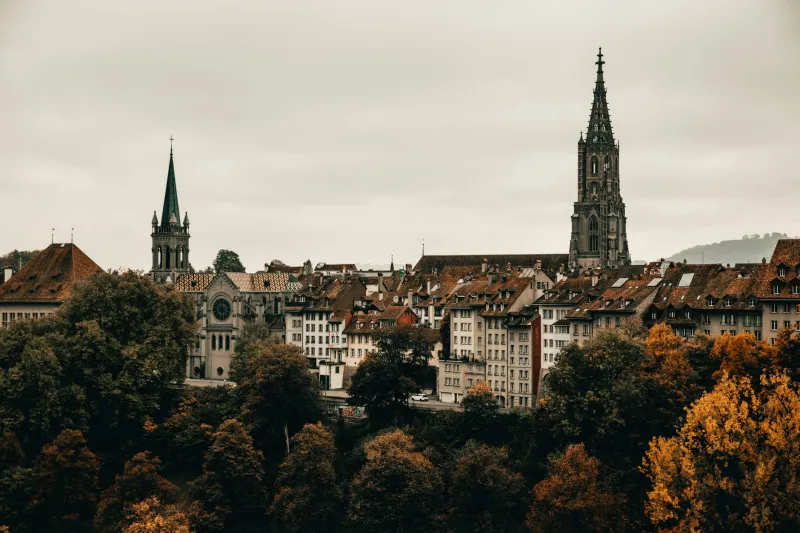
Most Americans know Switzerland the way they know a good supporting actor — familiar face, can't quite place the name. Zurich gets the finance crowd. Geneva gets the diplomats. The Alps get the Instagram skiers. And Bern? Bern sits there in the middle of it all, the actual capital of the country, doing what it has always done: thinking deeply, moving deliberately, and producing things that last.
That's not an accident. It's a culture. And right now, that culture is making some of the most interesting music on the planet.
A City Built for People Who Don't Rush
If you've ever walked Bern's old town — a UNESCO World Heritage Site, for what it's worth — you already understand something about the music coming out of it. The arcaded sandstone walkways, called Lauben, stretch for miles beneath the city's buildings, sheltering pedestrians from rain and snow without asking anything in return. The medieval clock tower, the Zytglogge, has been marking time with mechanical precision since the 13th century. The city doesn't perform urgency. It just is.
Einstein lived here from 1902 to 1909, working days as a patent clerk and spending his evenings turning theoretical physics inside out. He wasn't in a hurry. He was in the right environment — one that rewarded careful thought over loud proclamation. Bern gave him the space to be strange and serious at the same time.
That same energy hasn't left. It's just found a new outlet.
The Underground Nobody Talks About
Here's what surprises most people who actually spend time in Bern: the city has a genuinely rebellious underground. There's a reason it produced a disproportionate number of Swiss punk and alternative acts in the '80s and '90s. Bern has always had this productive friction between its buttoned-up civic identity and the artists who grow up inside it, pressing against the walls.
The Reitschule — a sprawling, graffiti-covered cultural center that the city government has tried to shut down approximately forever — has been a hub for independent music, radical politics, and countercultural art since the late '80s. It's the kind of place that shouldn't exist in a city of clock towers and federal government buildings. And yet there it is, thriving.
That tension — between order and instincts, between heritage and disruption — is exactly what shows up in the music. Artists from Bern tend to carry both things at once. The precision and the wildness. The patience and the edge.
What "Deliberate" Actually Sounds Like
American music culture has a complicated relationship with deliberateness. We celebrate artists who seem effortlessly prolific — who drop projects constantly, who stay in the conversation, who move fast enough that nobody can ever quite catch them. The grind is the story. The output is the proof.
Bern operates on a different logic. Artists here tend to take their time not because they're slow, but because they're thorough. There's a local saying — not an official one, more of a cultural attitude — that roughly translates to: don't say it until you mean it. You hear that in the music. Arrangements that feel considered rather than assembled. Lyrics that land like they were chosen from a much longer list. Sonic textures that reward repeated listening because they were built with repeated listening in mind.
This isn't nostalgia or pretension. It's craft treated as a serious discipline, the same way Bern's watchmakers and architects and engineers have always treated theirs.
The Global Reach of a Local Sound
What makes the Bern sound particularly interesting right now is how it's traveling. We're in a moment where American listeners — especially younger ones — are actively seeking out music that feels like it was made by a human being with something real to say. The algorithmic assembly line has produced a kind of collective exhaustion. People want to feel something again.
Artists rooted in Bern's culture of careful, unhurried creation are landing differently in that context. Not because they're exotic or because the "European mystique" is doing the heavy lifting, but because the music itself holds up. It doesn't fall apart on the third listen. It opens up.
There's also a multilingual dimension worth noting. Bern sits at the crossroads of German-speaking and French-speaking Switzerland, which means artists here often navigate multiple cultural frameworks just by existing in their city. That kind of fluency — moving between registers, between traditions, between emotional vocabularies — tends to produce music with more range than you'd expect from a city of 130,000 people.
Why This Matters for American Ears
If you're an American music fan who's been feeling like something is missing from your playlists, Bern is worth paying attention to for a specific reason: it represents a model of artistry that we've largely deprioritized in the US, but never actually stopped wanting.
We still respond to music that was built to last. We still lean into songs that feel like the artist had something to prove to themselves, not just to an audience. We still get caught off guard by arrangements that don't telegraph every move three seconds in advance. Bern produces that kind of music consistently — not as a trend, but as a reflection of how the city itself moves through the world.
Einstein didn't come to Bern and get inspired by its scenery. He came, found a culture that took ideas seriously and gave them room to breathe, and changed everything. The artists growing up in that same city today haven't changed the laws of physics. But some of them are doing something to the way music feels — something quiet, something patient, something that sticks.
You've probably been missing it. Now you know where to look.