The Sound of Altitude: How Switzerland's Mountains Secretly Shape the Music You Can't Stop Playing
The Sound of Altitude: How Switzerland's Mountains Secretly Shape the Music You Can't Stop Playing
Close your eyes and think about the last song that genuinely stopped you in your tracks. Not the one that was engineered to go viral, but the one that felt like it arrived from somewhere real — somewhere with weather, with silence, with actual geography. Chances are, that song carried the fingerprints of a place.
For Nicola from Bern, that place has always been Switzerland. And it's not just a postcard backdrop.
Bern Isn't Just a Capital — It's a Frequency
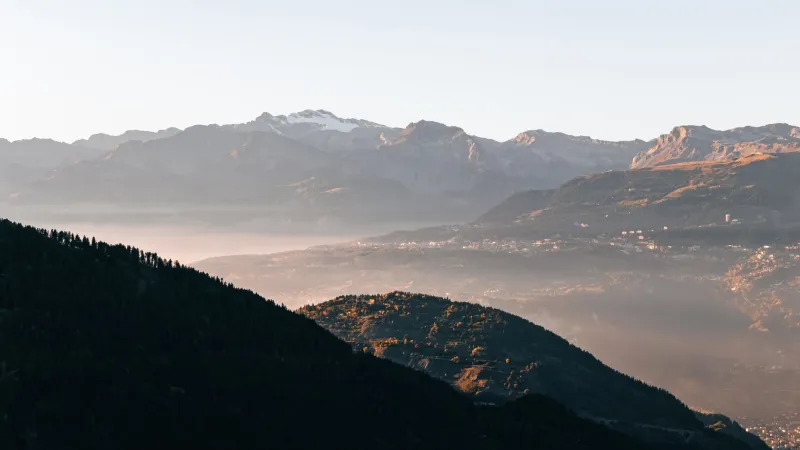
Most Americans know Switzerland for watches, chocolate, and maybe a vague association with neutrality. What gets overlooked is the country's extraordinary sensory landscape — the kind that doesn't announce itself but seeps into everything. Bern, nestled in the Mittelland plateau with the Bernese Alps rising dramatically to the south, operates at a particular emotional pitch. The city is medieval in its bones but quietly modern in its rhythm. Cobblestone arcades, rushing river bends, and the distant hum of mountain wind create an ambient texture that's impossible to ignore if you grow up inside it.
 Photo: Bernese Alps, via cdn.pixabay.com
Nicola did. And that upbringing didn't just shape a personality — it shaped an entire sonic vocabulary.
"When you grow up surrounded by that kind of scale," Nicola has said, "you develop a different relationship with space in music. Silence isn't absence. It's presence."
That philosophy shows up in every arrangement, every breath between notes, every decision to let a melody breathe instead of filling it with noise.
The Echo Chamber No Studio Can Replicate
There's actual acoustic science behind why mountain environments influence musical sensibility. Alpine valleys are natural reverb chambers. Sound travels differently at elevation — it disperses more slowly, decays more cleanly, and carries farther. Growing up in that environment trains your ear to hear music spatially, dimensionally. You become attuned to the relationship between a sound and the silence that frames it.
This isn't just poetic speculation. Musicologists have long noted that folk traditions from mountainous regions — whether Swiss, Appalachian, or Andean — share a common quality: they're built for open air. They have what you might call reach. They're designed to travel.
Nicola's music carries that same quality, even when it's playing through earbuds on a subway in Manhattan. There's a spaciousness to it that feels borrowed from somewhere vast. American listeners, many of whom are quietly starved for music that doesn't feel manufactured in a vacuum, respond to that without necessarily being able to name why.
Winter as a Creative Collaborator
Swiss winters deserve their own conversation. Not the ski-resort version that shows up in Instagram reels, but the actual lived experience of alpine winter — the weeks of low fog that settle over Bern like a soft ceiling, the particular stillness of a snowfall in the pre-dawn hours, the way cold air makes everything feel more deliberate.
For artists, that environment functions almost like enforced introspection. When the world outside contracts and quiets, the inner creative life tends to expand. Many of Nicola's most textured compositions have roots in those winter months — not as a seasonal aesthetic choice, but as a natural consequence of what that environment does to the imagination.
This resonates deeply with American listeners who are increasingly burned out by the relentless pace of content consumption. There's a hunger in the US right now for music that feels like it took time. Music that sounds like someone actually sat with it before releasing it into the world.
Culture as Invisible Ingredient
Beyond geography, Swiss culture itself carries musical implications that are easy to underestimate. Switzerland is a country of four official languages and distinct regional identities compressed into a space roughly the size of Vermont and New Hampshire combined. Navigating that kind of cultural density from birth creates a particular kind of artistic fluency — an ability to move between registers, to code-switch emotionally, to find common ground without erasing specificity.
Nicola's music reflects that cross-cultural dexterity. It doesn't flatten itself into a single genre or pander to a single demographic. It holds multiple influences simultaneously — folk textures, contemporary production, classical restraint, and genuine emotional directness — without any one element overwhelming the others.
For American audiences, that kind of musical balance feels fresh precisely because it resists the hyper-categorization that dominates streaming platforms.
What 'Place' Actually Does to Music
The broader argument here isn't just about Switzerland. It's about the idea that place is an active ingredient in music, not a passive backdrop. The best artists aren't just products of their technique or their influences — they're products of their environments. The light quality, the social rhythms, the ambient soundscape of where you grew up all leave marks on how you hear and how you create.
What makes Nicola's work compelling to American ears is partly novelty, sure. But it's more than that. It's the sense that the music comes from a specific, rooted somewhere — a somewhere with seasons and stone and a particular quality of mountain quiet that doesn't exist in Los Angeles or Nashville or New York.
In an era when so much music is made about everywhere and therefore from nowhere, that rootedness feels genuinely rare. It feels, to borrow a word that gets overused but still applies here, authentic.
And that's something no algorithm can generate. The Alps have to do it for you.