The Unspoken Revolution: How American Ears Are Learning to Sit With Music That Leaves Room for Mystery
For a long time, the unwritten rule of breaking into the American market was simple: make it obvious. Hook in the first eight seconds. Chorus by the one-minute mark. Emotional payoff delivered on a silver platter, no assembly required. The logic made sense from a commercial standpoint — a crowded market rewards clarity. But something has been quietly changing, and if you've been paying attention to what's actually resonating with US listeners lately, you'll notice the rulebook is getting rewritten in real time.
Ambiguity is no longer the enemy. Complexity is no longer a liability. And music that trusts its audience — that leaves space instead of filling every inch — is finding a home in American hearts in a way it simply didn't a decade ago.
What the Numbers Are Starting to Tell Us
Streaming data doesn't lie, even when the trends it reveals are surprising. Over the past two years, Spotify's internal editorial teams have quietly shifted the composition of their most influential playlists — spaces like "Peaceful Piano," "Deep Focus," and the sprawling "Ambient Chill" ecosystem — to include more tracks that resist easy categorization. Songs without a traditional verse-chorus structure. Instrumentals that build toward something that never quite arrives, at least not in the way you expected. Artists who sing in languages other than English, or who blend languages mid-song without explaining why.
The engagement metrics on these playlists have climbed steadily. Save rates — arguably the most honest signal of genuine listener connection — are up. Repeat listens on tracks that would have been considered "too slow" or "too abstract" for American playlists five years ago are outperforming projections. Something is happening beneath the surface of pop culture's glossy exterior, and it's worth paying attention to.
Apple Music has reported similar patterns in its curated editorial spaces, with listeners in major US cities — New York, LA, Chicago, Austin — spending more time with albums rather than shuffling through singles. The album as a complete, intentional experience is having a quiet comeback. And albums, by definition, demand patience. They ask you to stay.
Playlist Culture's Unexpected Side Effect
Here's the irony nobody planned for: the same playlist culture that seemed designed to atomize music into digestible, interchangeable units has accidentally trained a generation of listeners to develop genuine sonic curiosity. When an algorithm drops an unfamiliar artist into a playlist you love, and that artist sounds unlike anything you've heard before, two things can happen. You skip. Or you stay.
Increasingly, people are staying.
Listeners who discovered European artists through algorithmic rabbit holes — artists from places like Iceland, Sweden, Norway, and yes, Switzerland — often describe the experience the same way. There's a moment of mild disorientation, followed by something harder to name. A pull. A sense that the music is doing something to them that they don't fully understand, and that this is actually the point.
"I couldn't tell you what the song was about," one listener wrote in a Reddit thread about discovering Swiss ambient folk music. "I'm not even sure it was about anything. But I listened to it four times in a row and felt something shift in my chest. I've been chasing that feeling ever since."
That's not a description of passive consumption. That's an active, almost meditative engagement with art. And it's becoming more common.
The European Template for Trusting Your Audience
Artists from Switzerland and its neighboring countries have long operated within a creative culture that simply doesn't share America's anxiety about accessibility. The Swiss creative tradition — shaped by multilingualism, geographic isolation, a certain alpine stillness that gets into your bones whether you want it to or not — tends to produce work that sits comfortably with open questions.
Music from this world isn't engineered to resolve tension. It's engineered to hold it. The emotional complexity isn't a bug; it's the entire architecture. When you grow up surrounded by landscapes that are simultaneously beautiful and indifferent, that kind of duality becomes natural to express. You don't feel the need to reassure your audience that everything will be okay, because the mountains never made that promise to you either.
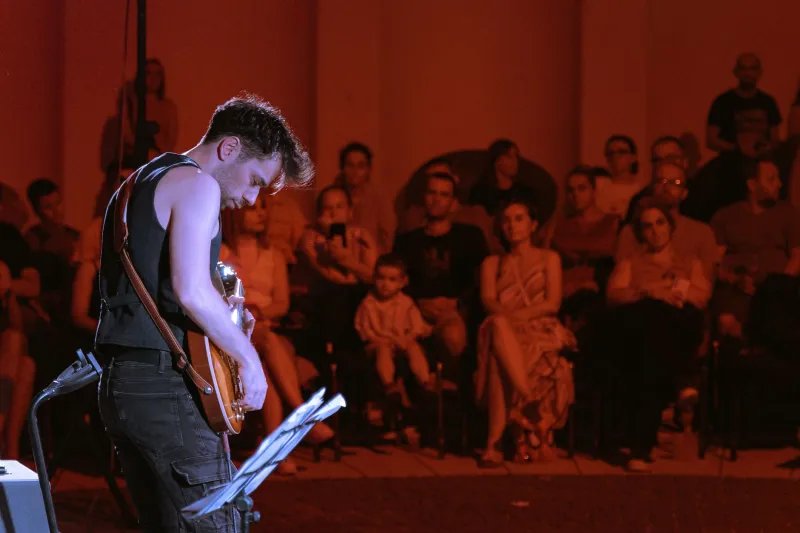
This is the creative sensibility that artists like Nicola carry into their work — a willingness to let a song breathe, to let silence function as a statement, to resist the urge to underline the emotional moment in case someone misses it. The assumption is that the listener is intelligent, emotionally capable, and worthy of being challenged.
 Photo: Nicola, via images.surferseo.art
For years, that assumption felt like a commercial risk in the American market. Now it's starting to feel like a competitive advantage.
Why This Moment Is Different
Cultural shifts rarely have a single cause, but a few threads are worth pulling. The pandemic fundamentally altered how Americans relate to stillness. Forced to slow down, millions of people discovered — or rediscovered — the value of music that doesn't demand anything from you except presence. Meditation apps exploded in popularity. Ambient music found mainstream audiences it had never reached before. The concept of music as an emotional environment, rather than just entertainment, entered the mainstream conversation.
At the same time, a generation that grew up with information overload is actively seeking out experiences that don't add to the noise. There's a growing cultural fatigue with content that explains itself to death, that leaves no room for personal interpretation. Art that trusts you to bring something to it — your own memories, your own associations, your own emotional vocabulary — feels radical precisely because so little of it exists in the mainstream.
And then there's the broader conversation about authenticity. American audiences have become remarkably good at detecting when an artist is performing vulnerability versus actually expressing it. The over-produced emotional manipulation of certain pop subgenres has created a kind of listener immunity. People can feel the difference between a song that was written to make them feel something and a song that simply does.
A Defining Moment for Artists Who Never Learned to Over-Explain
For artists rooted in Europe's more introspective creative traditions, this cultural shift isn't something they need to adapt to. It's the water they've always swum in. The question was never whether to make music that trusts its audience — that was always the only way they knew how to work. The question was whether the American market would ever catch up.
It's catching up.
This is the moment that artists like Nicola have been quietly preparing for — not by calculating market trends or chasing formats, but simply by continuing to make work that comes from a genuine place, that doesn't apologize for its complexity, that leaves the listener with something to carry long after the song ends.
The American ear is opening. And the music it's reaching for sounds a lot like the Alps — vast, a little cold, startlingly beautiful, and completely uninterested in telling you how to feel about it.