One Song, a Hundred Nights: Notes on Playing the Same Thing Until It Tells the Truth
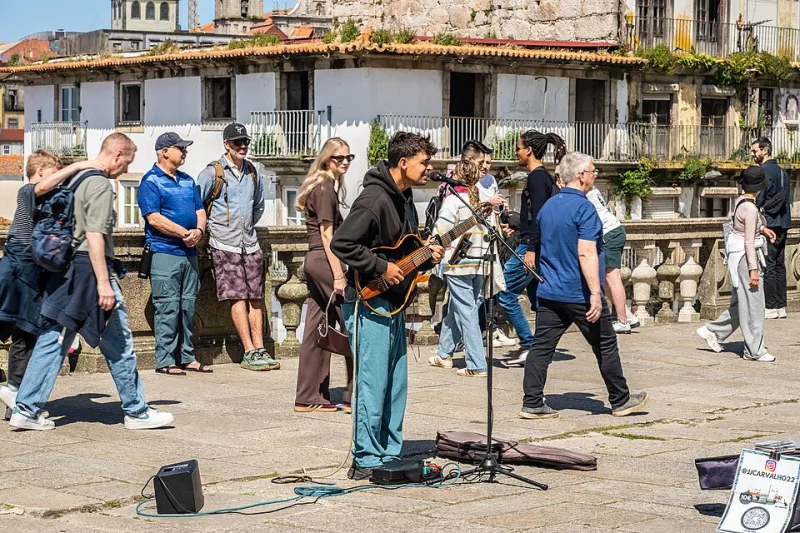
Photo: Michael Gaylard from Horsham, UK, CC BY 4.0, via Wikimedia Commons
The song is called Late Train Home. It's three and a half minutes long, it has four chords, and by the end of last year's touring I had played it close to a hundred times in front of people across the United States. I want to tell you what that did to it, because I expected the opposite.
I expected to be sick of it. Everyone warns you about that — the hit you have to play, the one that makes the setlist feel like a chore. What actually happened was stranger and more useful: the song kept telling me things.
The arrangement starts shedding
By night eight or so in the Midwest, I noticed I'd stopped playing the second guitar figure in the intro. Not a decision. It just fell away, and the song sounded better without it. By night twenty, the bridge had lost a chord. By night thirty, the drummer was doing half of what was on the record during the outro, and the room got quieter instead of louder.
Repetition is a slow-motion edit. When you play something a hundred times, the parts that were carrying emotion survive and the parts that were carrying habit get dropped. You can't do that math in a rehearsal room, because there's no audience in the equation yet. The audience is the thing that tells you which note mattered.
The tempo finds its real home
On the record it's 84 beats per minute, because that's what sounded lively through studio monitors at 2 a.m. Live, 84 felt like rushing a story. We crept down to 79 over about a month, and the song stopped sounding nervous.
In Switzerland we talk about this as if it's obvious: the version you record is a hypothesis, and the version you tour is the experiment. What surprised me is how much the American rooms shaped the result. In a packed 250-cap in the Northeast, the crowd's energy pushed us up and I'd have to pull it back. In a seated theater in the Northwest, 79 was almost too fast for the silence in the room.
We ended up with a tempo that shifted by a beat or two depending on the night. That sounds like sloppiness on paper. In practice, it's the difference between performing a song and reciting it.
What the audience does that you can't rehearse
There's a moment in the last verse where the lyric lands on the word home, and one night in Portland a few hundred people sang it before I did. Not a planned singalong. Just a room that had heard the song enough times to lean forward.
Once you've felt that, the verse stops being yours. Every night after, I left a small pocket of space before that line. Half a second. Enough for the room to decide whether it wanted to fill it.
That's not a gimmick and it's not a cue. It's what happens when you've played something enough times to stop guarding it.
Swiss discipline, American immediacy
Here's the honest split. The training I grew up with treats a set like a structure — timing, transitions, arrangements that don't move once they're locked. The rooms I played in the States taught me that a structure is only useful if it can survive contact with a crowd that hasn't read the plan.
Both instincts are right, and each one corrects the other. Discipline keeps the hundredth performance from becoming a shrug. Immediacy keeps it from becoming a recital. If you have too much of the first, the show is precise and dead. Too much of the second, and it's alive but formless — a night that felt great and that nobody, including you, can remember.
The test I use now
Before a long run, I pick one song and decide it's allowed to change. Everything else stays where it is so the set has a spine. Then I keep a note in my phone after each show: one line about what the song did that night.
By the end of the run, that note is a record of a hundred small experiments, and about four of them are worth keeping. Four is plenty. It's more honest than a rewrite done at a desk, because each of those four changes had to survive an actual room full of strangers first.
Why repetition isn't the enemy
Freshness gets talked about as if it's a property of the material. It isn't. It's a property of attention. A song you've played a hundred times can still surprise you if you're listening for what's changed — in the tempo, in the silence, in the crowd, in yourself.
The song didn't get old. It got specific. And specific is the only thing an audience has ever responded to.