Strangers Who Made Something Beautiful: The Hidden Power of Never Meeting Your Collaborator
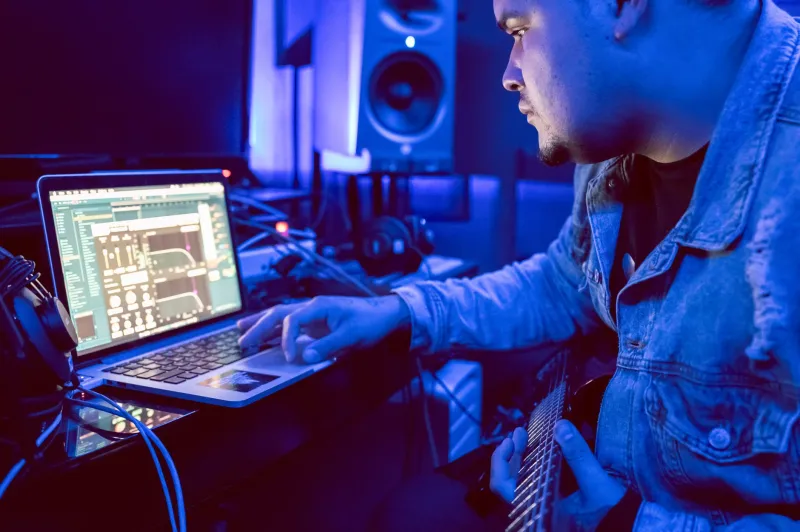
There's a moment that every remote collaborator knows. You send a file across an ocean — a half-finished melody, a rough vocal take, a drum pattern you recorded at midnight — and then you wait. Hours pass. Sometimes a full day. And when the file comes back, it's been transformed by someone who has never seen your face in natural light, never heard you laugh at your own jokes, never watched you pace around a studio when a chord progression isn't landing.
And somehow, it's exactly right.
This is the paradox sitting at the center of a growing wave of transatlantic music-making. American artists and Swiss producers are finding each other online, collaborating across seven time zones, and producing work that neither could have made alone. The strange part? The distance might be the whole point.
What the Absence of a Room Forces You to Do
When you're in the same physical space as a collaborator, communication gets lazy. You can gesture. You can hum something vague and hope they catch it. You can say "more of that vibe" and wave your hand in a way that somehow makes sense in the moment.
Take that away, and you have to be precise. You have to write it down. You have to use words — real words — to describe the emotional texture of what you're trying to build.
Singer-songwriter Maya Ellison, based out of Nashville, started working with a Bern-based producer named Stefan Rüfenacht in 2021 after connecting through a music forum. They spent eight months building an EP without ever sharing the same room. "I had to learn how to articulate things I'd never articulated before," she said in an interview. "Like, what does this bridge actually need to feel like? I couldn't just play it and say 'you know.' I had to explain it. That process made me understand my own music better."
This kind of enforced intentionality is one of the quieter gifts of remote collaboration. You can't coast on chemistry. You have to build it deliberately, word by word, file by file.
The Swiss Side of the Equation
There's something about working with Swiss creatives specifically that seems to accelerate this process. Bern has a cultural relationship with precision that runs deep — it's not a cliché, it's a lived reality. The city thinks methodically. It plans. It considers. And when that sensibility meets the looser, more instinct-driven approach that characterizes a lot of American music-making, the collision is genuinely productive.
American artists tend to move fast and fix it later. Swiss producers tend to consider first, then act. Neither approach is wrong. But when they meet in the middle — when the American artist's raw energy gets filtered through a Swiss collaborator's deliberate ear — you often end up with something that has both fire and form.
Producer and multi-instrumentalist Lena Moser, who splits her time between Bern and the digital ether of international music-making, puts it plainly: "American artists bring me things that are alive, sometimes almost chaotic. My job is not to tame that. It's to give it a shape without killing what makes it breathe."
Time Zones as Creative Tools
Here's the thing nobody talks about: the time zone gap is actually useful.
When a New York artist sends something to Bern at the end of their workday, that file is waiting in a Swiss inbox when the producer wakes up. The producer works on it through their morning. By the time the American artist is back at their desk, there's something new waiting for them. The project moves almost continuously, passed back and forth like a relay baton.
But more than the logistics, the gap creates breathing room. You can't obsess over a note in real time. You send it, and then you let it go. And when it comes back, you're hearing it with fresh ears instead of the exhausted ones you had when you first recorded it.
This forced detachment from your own work is something that music schools charge thousands of dollars to teach. Remote collaboration gives it to you for free.
Trust Without a Handshake
The other thing that makes these partnerships work — when they do work — is a different kind of trust. Not the kind you build over drinks at a bar or through years of shared history. It's trust built through the work itself.
You learn to trust a collaborator by watching how they handle your ideas. Do they preserve what matters? Do they push back thoughtfully when something isn't working? Do they bring something of themselves without erasing you?
Chicago-based guitarist and producer Darnell Watkins has completed three projects with European collaborators over the past four years, two of them with artists based in Switzerland. "You learn someone's values through their edits," he says. "More than you'd learn from meeting them for coffee. The music tells you who they are."
That might sound like a stretch, but spend time in this world and you'll start to believe it. The way someone treats your rough demo reveals a lot about their creative ethics.
What This Means Going Forward
The pandemic accelerated remote collaboration out of necessity, but the best of what came out of that era didn't evaporate when studios reopened. Artists who discovered genuine creative partnerships across borders kept them. They'd found something that worked, and geography couldn't take it away.
What's emerging now is a generation of musicians who don't think about collaboration in terms of proximity. They think about it in terms of fit. Who understands what you're trying to do? Who challenges you without flattening you? Who brings something you genuinely can't replicate on your own?
For a growing number of American artists, the answer to those questions has a Swiss area code. And the music they're making together — built across time zones, over months of careful file-sharing and precise communication — is some of the most honest work either side has ever produced.
Distance, it turns out, has a way of cutting straight to what matters.